
Feminism, but make it catchy.
Revisiting Paris Paloma and the relationship between women, witches and capitalism.

Last year I went down more than rabbit holes than Alice herself as I began to unpick the threads of the modern image of the witch and its relationship to feminism.
I’d fallen in love with Paris Paloma in 2023 and was delighted to hear her anthem ‘Labour’ on mainstream radio a year or so later. One of the key areas I’d started to explore was the relationship between the witch and capitalism, and Paloma’s banger of a tune tapped into this through its subject matter of female labour and how it is exploited, undervalued and invisible.
In a world saturated with sugarcoated, sickly sweet songs that celebrate toxic romantic dynamics, Paloma’s track is both informative and an earworm.
Women and Accumulation
Before I go off on one about why the labour split between genders is still bonkers, I think it’s important to shoehorn in why our capitalist society is never going to be fair to anyone who is not white, straight and male.
Silvia Federici’s seminal text Caliban and The Witch: Women, The Body, and Primitive Accumulation (2004) is an exploration into the relationship between capitalism, female power and the persecution of women as ‘the other’. It explores how women are coded as lesser in the ‘hierarchical ranking of human faculties’ which led to the ‘consolidation of patriarchal power’. Lesser = negative and the witch was identified as the most negative of all. As capitalism replaced the feudal system that dominated Europe from the 15th century onwards, women (accused of being witches) were persecuted for the best part of three centuries.
The main argument of Federici, and also a key concept in modern feminism, is that female power is not compatible with capitalism, as capitalism benefits directly from the exploitation of female labour.
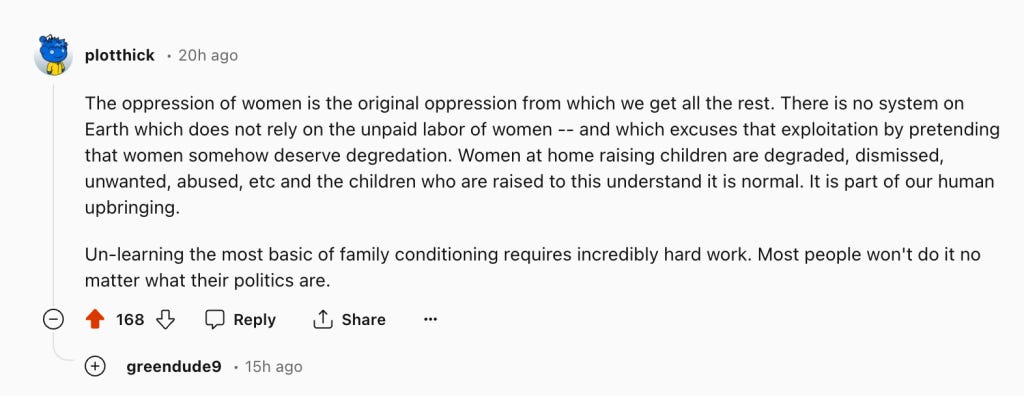
The incompatibility of capitalism and female power is still embedded in modern society. I came across a thread on Reddit (R/Feminism) where one user summed up the relationship between capitalism and female oppression and exploitation nicely:
Challenging Relationship Dynamics
Luka Lesson once pointed out that it is not ‘behind every great man is a great woman, but in front of every great woman is a mediocre man’. The idea that woman’s labour is somehow not as valuable, or that the home sphere of domestic chores and raising the next generation is not as much part of the real world as traditionally public, male spaces like business and politics is not only flawed, it’s fucking infuriating. Yet it’s a comfortable fallacy a lot of people will put up with because undoing basic social conditioning is really hard work and we’re too busy trying to outrun the cost of living.
Labour is a song that laments relationships where one party does the majority of heavy lifting (both emotional and physical). Whilst there are men who hear the words and realise they’re not equal in their relationship, it is a more ‘common of an experience… for women because of the way that [they’ve] been programmed to view heterosexual relationship dynamics. And it’s so normalized’ (source).
To-the-point lyrics including ‘I know you’re a smart man, and weaponise the false incompetence, It’s dominance under a guise’ offer a courageous contrast to other chart songs. The song culminates in a chorus of women exposing the double bind of expectations they face in modern society:
All day, every day, therapist, mother, maid
Nymph then a virgin, nurse then a servant
Just an appendage, live to attend him
So that he never lifts a finger
24∕7, baby machine
So he can live out his picket fence dreams
It’s not an act of love if you make her
You make me do too much labour
The growing popularity of the song shows a shift in mass culture and its awareness of feminine range. Whilst I’m sure it’s a track that divides opinions, it is also clearly carrying a message that is resonating. ‘Female issues’ are becoming a more mainstream subject matter that refuse to be swept under the rug of ‘it’s gone too far’.
As Good A Reason
Whilst the relationship between feminism, witches and capitalism is an essay for another day (or rather, several essays because this topic is messy AF), I’m delighted to report that Labour isn’t just tapping into the female consciousness to make money, because it is not the only song on the record that’s raising the feminist agenda.
As Good A Reason is more upbeat than Labour but once again showcases Paloma’s narrative style. This time she explores her relationship to the male gaze, existing within patriarchal systems and the realisation that liking yourself in a world that profits from your doubts is an act of resistance.
Every time you are succeeding
There's an old man somewhere, seething
And spite's as good a reason to take his power
When you hate the body you are in
Oh love, you're acting just for him
As he counts his gold and green in his ivory towerOur fear it lines his pockets love
So take that rage and bottle up
And put a drop into his cup of wine
You don't need him, you don't need me
With that poisoned bottle, you'll be free
But be damn sure you don't mix it up with mine
Given the state of current affairs and the number of billionaires who profit from data that does not belong to them globally, I really, really like the idea of taking my power back. It seems small and possibly futile, but also vital. Words like ‘resistance’, ‘rebellion’ and ‘protest’ can be overwhelming, and phrases like ‘dismantle the patriarchy’ sound too academic to really implement at 9.08 on a bus to work. The idea that choosing to like myself and invest my capital (and labour) into things that help me shine brighter, rather than in trends and formulas that aim to ‘perfect’ me sounds like a win. Of course, it’s not easy at all, but on the days when fighting the power seems a bit ‘eh’, knowing that I can chose to not buy in to systems that profit from my misery sounds pretty sweet.
What I really like though, is the line ‘But be damn sure you don't mix it up with mine’. I pondered it for a few weeks and came to the conclusion that it’s a commentary on our culture of women vs women. It’s an invitation to get angry, be uncouth enough to be petty and spiteful, but direct it accordingly.
And I Said Spite
I recently decided to reconcile the human need to create and the designer’s need to hone my craft by creating things as I untangled my thoughts. Initially I wanted to play with some badass blackletter type to create a grunge-y brutalist poster. This didn’t feel like the end of the road for the creative itch I felt for these songs so I took to After Effects to create some motion.